

Which Inverter Battery Is Best for Home Use?
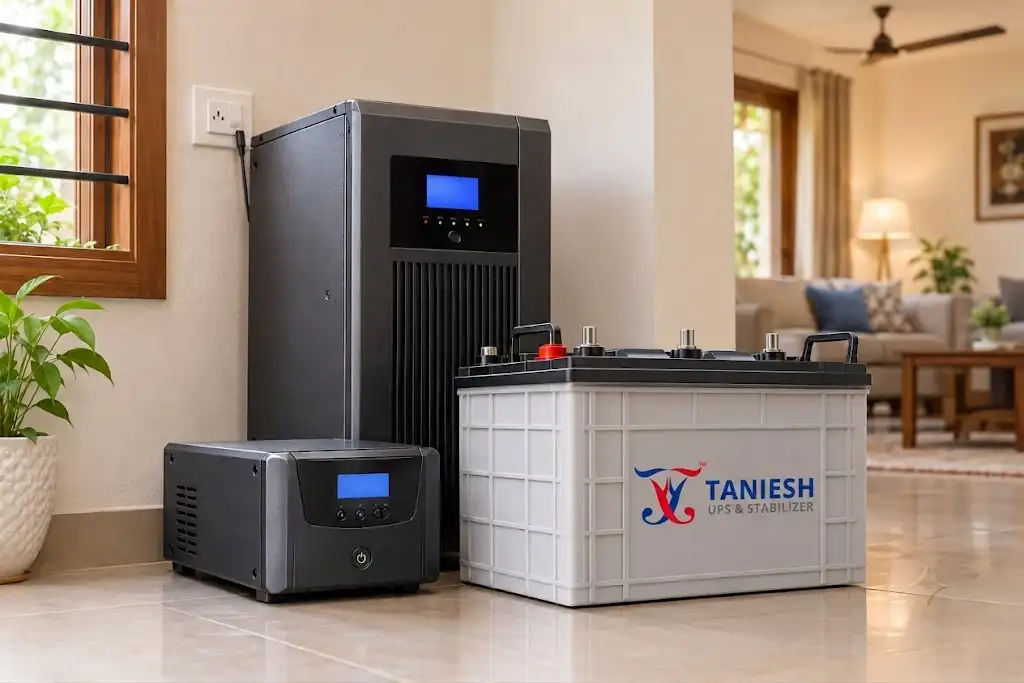
Choosing the right battery for your home helps you maintain a reliable power supply during unexpected power cuts. Whether you need backup for lights, fans, a television, or a Wi-Fi router, the right battery can improve convenience and help you manage electricity interruptions.
However, choosing a suitable battery involves more than comparing prices. You should consider battery type, capacity, backup time, maintenance, lifespan, and compatibility with your inverter.
The best inverter battery for home use depends on your household’s electricity requirements, the duration of power cuts, and your budget. This guide explains different battery types, capacity options, and important buying factors to help you make an informed decision.
How Does an Inverter Battery Work?
An inverter battery stores electrical energy and supplies it when the regular electricity supply is interrupted. The inverter converts the battery’s direct current (DC) electricity into alternating current (AC), which most household appliances use.
The process works in four stages:
- Charging: The battery stores energy while mains electricity is available.
- Power interruption: The inverter detects a power cut and switches to battery operation.
- Power conversion: The inverter converts DC electricity into AC electricity.
- Backup operation: Connected appliances receive power until electricity returns or the battery reaches its discharge limit.
For example, a household operating two fans, three LED lights, and a Wi-Fi router needs sufficient stored energy to power these appliances for the desired duration.
Backup time depends on the total appliance load, battery capacity, inverter efficiency, and battery condition. High-power appliances consume energy more quickly.
Tip: Identify which appliances you need during a power cut before choosing a battery. This helps you estimate your actual power requirements.
Best Inverter Battery for Home
The right battery should provide sufficient backup while remaining compatible with your inverter and budget.
Common options include tubular lead-acid batteries, flat-plate lead-acid batteries, and lithium-ion batteries. Each has different characteristics relating to cost, maintenance, usable capacity, and expected lifespan.
Consider these factors before purchasing:
- Backup requirements: Decide how long essential appliances should operate.
- Capacity: Compare ampere-hour (Ah) ratings and battery voltage.
- Technology: Choose between suitable lead-acid and lithium-ion options.
- Maintenance: Check whether routine water top-ups are necessary.
- Warranty: Review coverage, exclusions, and service availability.
- Budget: Consider installation, maintenance, and replacement costs.
A higher Ah rating does not automatically mean a battery is the best choice. Its capacity must match your power requirements and inverter specifications.
Best Inverter Battery in India
Several established brands offer home inverter batteries in India, including Exide, Luminous, Amaron, Livguard, and Microtek.
Rather than choosing based on brand popularity alone, compare individual models.
| Factor | What to Check |
|---|---|
| Battery Type | Tubular, flat plate or lithium-ion. |
| Capacity | Ah rating and voltage compatibility. |
| Warranty | Coverage and conditions. |
| Maintenance | Water requirements and servicing. |
| Service | Availability of authorised support. |
| Price | Total purchase and installation cost. |
A tubular battery may suit households experiencing frequent power cuts, while lithium-ion options may appeal to buyers seeking lower routine maintenance.
Check the manufacturer’s current specifications and warranty before purchasing. Product availability, prices, and features vary between models.
Top 5 Inverter Batteries
When comparing five popular brands, evaluate the exact models rather than assuming one brand is suitable for every household.
| Brand | What to Compare |
|---|---|
| Exide | Capacity, battery type, warranty, and service. |
| Luminous | Tubular options, maintenance, and compatibility. |
| Amaron | Product specifications and warranty. |
| Livguard | Battery technology, capacity, and price. |
| Microtek | Compatible battery options and charging requirements. |
This is a brand shortlist, not a verified ranking of individual batteries. Performance depends on the model, installation, usage, and maintenance.
Before deciding, compare at least three models with similar capacities. Review their warranty terms, charging requirements, and local service availability.
Best Home Inverter Battery
A suitable home battery should deliver sufficient backup, operate safely with the inverter, and provide reasonable long-term value.
Start by calculating the combined wattage of the appliances you want to operate. Next, determine the desired backup duration and identify a battery with sufficient usable energy.
For example, appliances consuming 250 watts for three hours require 750 watt-hours of energy at the appliance level. Additional capacity is needed to account for inverter losses and battery discharge limits.
Avoid selecting a battery solely because it has a high capacity. Choose one that meets your requirements without unnecessary expense
Looking for the right inverter battery for your home? Explore Taniesh’s reliable power backup solutions to find the right fit for your needs.
Inverter Battery for Home Price
Battery prices vary according to capacity, technology, brand, warranty, and availability.
When comparing quotations, consider the following costs:
- Battery purchase price.
- Installation and delivery charges.
- Additional equipment, if required.
- Maintenance and servicing.
- Future replacement costs.
Request a quotation that specifies the exact model, capacity, taxes, installation charges, and warranty. Verify current prices with authorised sellers before making a purchase.
How to Choose an Inverter Battery for Home
Follow these steps to select a suitable battery.
- List essential appliances: Include lights, fans, routers, and other equipment you want to operate during power cuts.
- Calculate the load: Add the wattage of appliances running simultaneously.
- Estimate backup time: Decide how many hours you need.
- Compare battery types: Evaluate cost, maintenance, lifespan, and usable capacity.
- Check compatibility: Confirm the inverter supports the battery’s voltage and charging requirements.
- Review the warranty: Check coverage and service availability.
- Compare total cost: Include installation and expected maintenance expenses.
This approach helps you make a decision based on your household’s actual needs.
Best Inverter Battery for 2BHK Home
A two-bedroom home does not automatically require a particular battery capacity. The correct choice depends on the number of appliances, their combined wattage, and the desired backup duration.
For example, a household running two fans, four LED lights, and a router may need less capacity than one operating additional appliances.
Calculate the load, estimate the required backup time, and compare the result with the battery’s usable energy. A 150Ah battery may suit some households, but the actual requirement depends on usage and system specifications.
Best Inverter Battery for 3BHK Home
A three-bedroom home may have more appliances, but the number of rooms alone does not determine battery capacity.
List the appliances that must remain operational during power cuts. Calculate their combined wattage and estimate how long they need to run.
A higher-capacity battery may be appropriate if your requirements are greater. However, ensure the inverter supports the battery configuration and charging requirements.
Best Low-Maintenance Battery for Home Inverter
If you prefer minimal routine maintenance, compare lithium-ion batteries with maintenance-free lead-acid models.
Lithium-ion batteries generally do not require electrolyte water top-ups and may offer a longer cycle life, depending on the model and operating conditions. However, they may cost more initially.
Before choosing one, check inverter compatibility, battery management protection, warranty, installation requirements, and local service availability.
Remember that maintenance-free does not mean care-free. Follow the manufacturer’s instructions for inspection and safe operation.
Inverter Battery Capacity for Home
An inverter battery does not last for the same number of years in every home. A well-maintained battery can provide good performance for several years, but its lifespan can vary based on its type, usage, charging, temperature, and maintenance.
Battery capacity is commonly measured in ampere-hours (Ah). However, Ah alone does not determine how long a battery can power appliances. Battery voltage and usable energy also matter.
The nominal energy formula is:
Nominal energy (Wh) = Voltage (V) × Capacity (Ah)
| Battery Specification | Nominal Energy |
|---|---|
| 12V, 100Ah | 1,200 Wh |
| 12V, 150Ah | 1,800 Wh |
| 12V, 200Ah | 2,400 Wh |
These figures represent nominal energy before accounting for discharge limits, conversion losses, and operating conditions. Actual usable energy will be lower.
Inverter Battery for Home 150Ah
A 150Ah battery is a common option for household backup. A nominal 12V, 150Ah battery stores approximately 1,800Wh.
Its suitability depends on your appliance load, battery technology, inverter efficiency, and required backup time.
For example, a 200W load would consume 600Wh over three hours. The battery must provide sufficient usable energy to meet that demand after accounting for system losses.
Check the manufacturer’s specifications before deciding whether this capacity is suitable.
Best Inverter Battery for Home 200Ah
A nominal 12V, 200Ah battery stores approximately 2,400Wh, providing more nominal energy than a 150Ah battery at the same voltage.
The additional capacity may support a greater load or longer backup time. However, it may also cost more and require a charging system suitable for its specifications.
Compare the usable capacity, warranty, and total cost of both options. Choose the one that matches your calculated requirements.
Inverter Battery Backup Time
Backup time is the duration for which a battery can operate connected appliances during a power cut.
It depends on:
- Total appliance wattage.
- Battery capacity and condition.
- Permitted depth of discharge.
- Inverter efficiency.
- Temperature and operating conditions.
Reducing the connected load can extend backup time. Switching off unnecessary appliances is often a practical way to conserve stored energy.
How to Calculate Inverter Battery Backup Time
Use this simplified formula:
Backup time (hours) = Usable battery energy (Wh) × Inverter efficiency ÷ Load (W)
Consider a 12V, 150Ah battery with these illustrative assumptions:
- Nominal energy: 12 × 150 = 1,800Wh.
- Usable fraction: 70%.
- Inverter efficiency: 85%.
- Appliance load: 200W.
First, calculate usable energy:
1,800 × 0.70 = 1,260Wh.
Next, account for inverter efficiency:
1,260 × 0.85 = 1,071Wh.
Finally, calculate backup time:
1,071 ÷ 200 = approximately 5.36 hours.
The estimated backup time is about 5.4 hours under these assumptions. Actual performance may differ depending on battery condition, discharge characteristics, temperature, and load.
The 70% usable fraction is an example, not a universal recommendation. Follow the battery manufacturer’s guidance.
Tubular Battery vs. Lithium Battery
| Feature | Tubular Battery | Lithium-Ion Battery |
|---|---|---|
| Initial Cost | Often lower | Often higher |
| Maintenance | Some models require water top-ups | Usually no water top-ups |
| Weight | Generally heavier | Often lighter |
| Cycle Life | Depends on model and usage | Often longer, depending on chemistry |
| Charging | Requires compatible lead-acid charging | Requires compatible charging and protection |
Which Is Better: Tubular or Flat Plate Battery?
Both tubular and flat-plate batteries use lead-acid technology, but their construction differs.
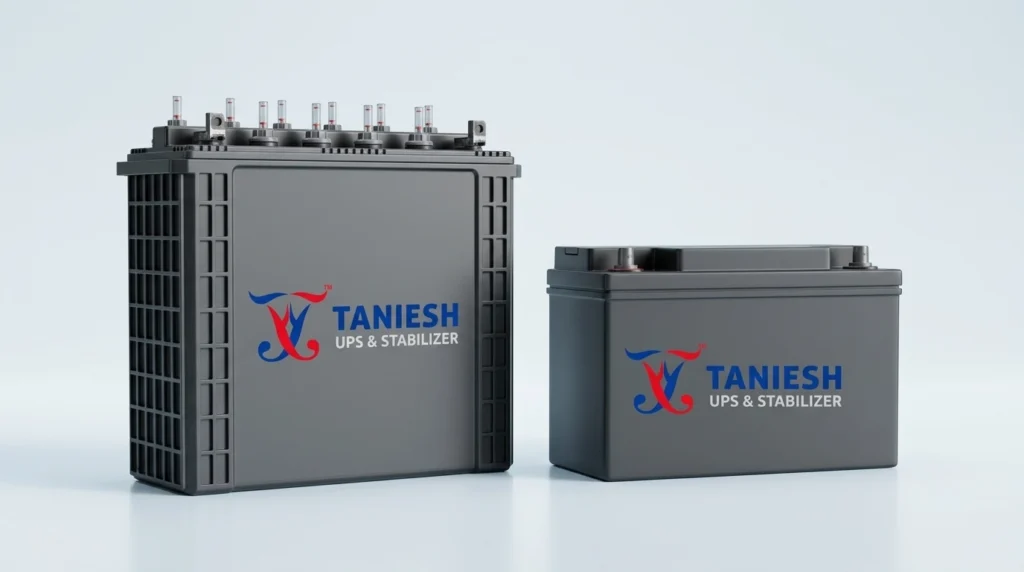
| Factor | Tubular Battery | Flat-Plate Battery |
|---|---|---|
| Typical Use | Frequent or longer backup | Light or moderate backup |
| Initial Cost | Often higher | Often lower |
| Lifespan | Depends on model and usage | Depends on model and usage |
| Maintenance | Varies by design | Varies by design |
Inverter Battery Lifespan
Battery lifespan depends on technology, charging conditions, temperature, discharge depth, maintenance, and usage.
To help extend battery life:
- Use a compatible inverter and charging profile.
- Avoid excessive discharge.
- Keep connections secure and clean.
- Follow the manufacturer’s maintenance instructions.
- Install the battery in a suitable location.
- Arrange professional inspection if performance declines.
Inverter Battery Maintenance
Flooded lead-acid batteries may require regular electrolyte-level checks and distilled-water top-ups according to the manufacturer’s instructions. Sealed batteries and lithium-ion batteries should not be opened.
Keep the installation area suitable for the battery type and provide the required ventilation. Never place metal objects across battery terminals.
If the battery leaks, swells, or becomes unusually hot, stop using it if safe to do so and contact a qualified technician.
Inverter Battery Replacement Signs
Common warning signs include:
- Significantly reduced backup time.
- Repeated low-battery warnings.
- Charging difficulties.
- Swelling, leakage, or visible damage.
- Unusual heating or damaged terminals.
These symptoms may also result from inverter or wiring problems. Arrange professional testing before replacing a battery unless visible damage requires immediate action.
Best Inverter Battery for Home Under ₹15,000
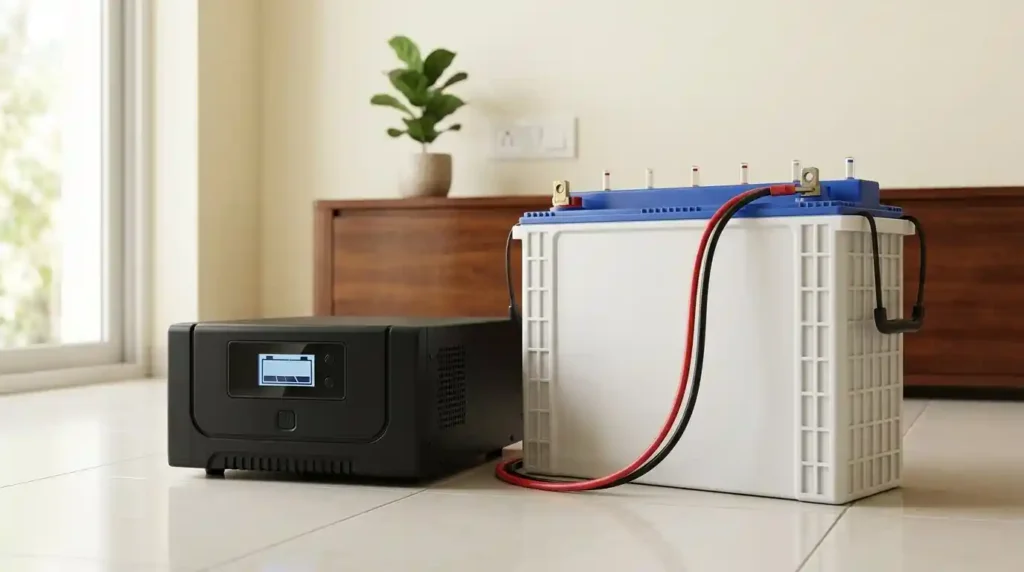
Within a ₹15,000 budget, available options depend on current prices, capacity, technology, and location.
Compare the battery’s voltage, Ah rating, warranty, maintenance requirements, and compatibility with your inverter. Check whether installation and delivery are included in the quoted price.
Do not choose a battery based on price alone. A lower-capacity model may not provide the required backup, while a more expensive product may offer features you do not need.
Best Inverter Battery for Home Under ₹20,000
A budget of ₹20,000 may provide additional options, depending on market prices and product specifications.
Compare two or three compatible models using these factors:
- Usable battery capacity.
- Expected backup requirements.
- Warranty and service availability.
- Maintenance requirements.
- Total installed cost.
If considering lithium-ion technology, confirm that the inverter supports the battery’s chemistry and charging requirements. Verify current pricing with authorised sellers before buying.
Key Points
Choosing a suitable home battery starts with understanding your power requirements.
- Calculate the combined wattage of essential appliances.
- Choose a capacity that meets your backup requirements.
- Compare tubular, flat-plate, and lithium-ion technologies.
- Check inverter compatibility and charging requirements.
- Review warranty, maintenance, and service availability.
- Compare total cost rather than purchase price alone.
- Follow manufacturer safety and maintenance instructions.
The right battery depends on your household’s usage, budget, and desired backup time. Compare specifications carefully before making a purchase.
Need help choosing a suitable battery for your home? Contact Taniesh UPS to discuss your power requirements and explore compatible backup solutions.
Frequently Asked Questions
. Which inverter battery is best for home use?
A tubular battery is a popular choice for home use because of its durability and backup performance. The best option depends on your power requirements, budget, and maintenance preferences.
Which inverter battery is best for a 2BHK home?
A 150Ah battery may suit a 2BHK home with essential appliances such as lights, fans, and a Wi-Fi router. The ideal capacity depends on your total power consumption and required backup time.
How long does a 150Ah inverter battery last during a power cut?
Backup time depends on the connected load, inverter efficiency, and battery condition. A 150Ah battery can provide several hours of backup for essential appliances, depending on usage.
Which is better for home use: a tubular battery or a lithium battery?
Tubular batteries are often more affordable initially, while lithium batteries are lighter and generally require less routine maintenance. Compare upfront cost, lifespan, and inverter compatibility before choosing.
How many years does a home inverter battery last?
Battery lifespan depends on its type, usage, charging practices, and maintenance. Following the manufacturer’s recommendations can help extend its service life.
Need Expert UPS Service?
Thanish Technologies — 30 years of trusted power solutions.
Our Products
Home UPS Series
600 VA – 5 kVA
Commercial Series
1 kVA – 20 kVA
Corporate Series
6 kVA – 120 kVA
Industrial Series
20 kVA – 500 kVA
Batteries & Stabilizers
All capacities
Popular Searches
Top 10 UPS Brands in India 2025
May 31, 2025 · 3 min read
Online vs Offline UPS — Full Comparison
Apr 20, 2025 · 5 min read
Top 10 UPS Brands in India 2025
Mar 5, 2025 · 4 min read
Online vs Offline UPS — Full Comparison
Mar 5, 2025 · 4 min read